- NC EP HCC Newsletter
- Posts
- EP HCC Newsletter - September 2025
EP HCC Newsletter - September 2025
Nevada County Emergency Preparedness - Health Care Coalition

Nevada County EP HCC
October 02, 2025
Emergency Preparedness
Health Care Coalition Newsletter
September 2025 | Issue #5

What's Inside:
News from the Public Health Emergency Preparedness (PHEP) Program
September is National Preparedness Month — but let’s be honest, it’s always preparedness month for us! We’ve taken some time to enjoy the changing colors and the changing weather, though. This amazing fall weather has brought cooler temperatures but not necessarily lower fire risk. So, although we’re thankful for all the rain - we understand fire season is still in effect!
Shelter Staff Training

The PHEP team has been using this seasonal transition time to organize our shelter supplies and work on a special project with our county partners from Office of Emergency Services (OES), Department of Social Services (DSS), Environmental Health and Probation. The project focused on creating a training video for new hires, to use as part of their on-boarding process. The video outlined the steps and guidance on being a shelter working for the County, during emergency events. It’s understood that when you hire on with Nevada County, you might be called upon to assist with setting up or staffing an emergency shelter. Our final creation (special shoutout to DSS for putting the final touches on the training video and making it looking AMAZING!) will help employees be ready for their time to support an emergency in Nevada County.
Shelter Support for Neighboring Counties
The PHEP team was invited to participate in a multi-county discussion to support Sierra County in updating their shelter plan and provide our experience in activating, setting up and staffing an emergency shelter. Again, we were able to work with colleagues from DSS to share our shelter experiences and help guide the work of other counties.

Plans have been made to continue these collaboration efforts between the neighboring counties who participated in the sheltering event (Sierra, Nevada, Lassen and Plumas). In a time of unknowns - budget cuts, climate change, capacity challenges… we are excited to support and be supported by partners outside of our county. We’ve talked about this so much lately, but collaboration is key to sustainability - and we’re so fortunate to have such great partners to lean on!
Coalition News
Are you COOP Ready?
In our last EP HCC meeting we talked a bit about essential functions and how to identify and prioritize those functions so your organization can continue to provide vital services to maintain the safety and well-being of general public during an emergency or downtime event. Essential functions also include those function that allow your organization to provide essential information to partners while also promoting the health, safety and emotional well-being of organizational staff.
At NCPH, we’ve included the following outline of priorities in our department Continuity of Operations Plan (COOP).

Priority Definitions for Essential Functions
We use this table to assign a priority to each program (priority level A-D) - and determine what kind of services we can offer during downtime: in-person only, remote or outside of county services. We also include which positions are essential in each program. The following is an example of the table that is used in the NCPH COOP:

This essential services table may be edited depending on needs at the time of the emergency to ensure that changing needs are addressed. Any programs or services not listed are not considered “Essential Services” and can be suspended during an emergency.
The PHEP team is happy to support any of our partners who are updating their COOP or anyone with any questions regarding setting up priorities for your essential services during a downtime event. Reach out to us at [email protected] for help!
PHEP Guest Writer - Holly Whittaker, Epidemiologist Nevada County Public Health
Wastewater Based Epidemiology
Wastewater based epidemiology is an important mechanism in public health that serves as detection system for increased infectious pathogens, potential outbreaks or high-risk substances in communities or sewersheds.. Detection of infectious pathogens in the wastewater system helps determine the presence of disease and to support other surveillance mechanisms in place such as communicable disease analytics and medical facility-based surveillance. Wastewater sampling results can help communities determine the severity of illness when viral or bacterial testing is limited or does not occur. Infectious pathogens levels can be monitored overtime to evaluate the impact of disease in our communities. This type of disease evaluation is considered an innovative means to help to determine when education and other prevention measures are promoted to minimize and mitigate the potential spread of illnesses in our communities; public health does not have to be exclusively dependent on laboratory results or clinicians to monitor disease in our communities.

National Wastewater Surveillance (NWWS), CDC.gov
Nevada County Public Health (NCPH) in collaboration with the California Department of Public Health (CDPH) initiated wastewater-based epidemiology in January 2024 with the Town of Truckee and April of the same year with the City of Grass Valley. Both sewershed locations collect 24-hour composites of wastewater samples several times a week (depending on their respective days) and submit the samples to their respective laboratories for analysis. Each sewershed’ s samples are tested for a variety of infectious pathogens which are listed below:
INFECTIOUS PATHOGEN | TOWN of TRUCKEE | CITY of GRASS VALLEY |
SARS-CoV-2 | ✓ | ✓ |
FLU A | ✓ | ✓ |
FLU A (H5) | ✓ | ✓ |
FLU B | — | ✓ |
RSV | ✓ | ✓ |
MPOX | ✓ | ✓ |
MEASLES | — | ✓ |
Using Wastewater Surveillance (WWS) in Emergency Preparedness Planning
NCPH obtains results for both locations via a dashboard as well as reports from CDPH. Both informational sources provide different types of information which NCPH staff utilizes to be globally aware of disease not only locally, but regionally and statewide. Each week staff evaluate the data to determine if there is an increase in specific diseases in the wastewater samples, but also to compare to previous years’ data. An example of this would be when an increase in a pathogen is detected in the wastewater samples, NCPH’s Public Health Officer and communicable disease team may distribute a Public Health Officer Advisory or Alert to health care providers giving essential information. NCPH’s communicable disease team may also determine the need to prepare for increased case investigation or testing supplies to help our medical partners if necessary.
Staff also evaluate data results to determine possible seasonality and when illness acutely impacts our communities. Influenza season is monitored through the fall and winter months to determine the peaks of illness, and which type of pathogen is seen in our communities initially i.e. Flu A vs Flu B. The graph below shows Influenza A periodically throughout Flu season last year. Having this information in conjunction with additional surveillance data allows NCPH to plan educational material and influenza vaccine clinics to help minimize the spread of flu.

Limitations of Using WWS
Wastewater based epidemiology will continue to evolve and become more specific to evaluate disease severity in our communities. However, a significant limitation to this type of epidemiology is the use of septic tanks. Since septic tanks are not part of wastewater treatment plants, and many Nevada County residents rely on septic systems, NCPH can only make inferences on disease illness for the areas of Nevada County that don’t participate in wastewater treatment systems.
As testing becomes more precise for infectious pathogens, NCPH looks forward to exploring innovative ways to utilize this data and analytics for high-risk substances and emergency preparedness.
Have questions about wastewater surveillance? Feel free to reach out to Holly Whittaker at [email protected]. You can also visit Division of Communicable Disease Control for information on California’s wasterwater surveillance system and data.
Partner Spotlight
This month’s partner spotlight is a team that many of you probably don’t know much about. They do important work, in the background, to keep our community informed, safe and ready to respond.
A big shoutout to the crew over at the Northern Sierra Air Quality Management District! They tirelessly work behind the scenes to support our community’s air quality. Whether it’s issuing permits for portable engines, or open outdoor burning (prescribed burns) or analyzing air quality data that streams in from one of their many monitoring devices, this team is helping us to breathe a little easier here in Nevada County!
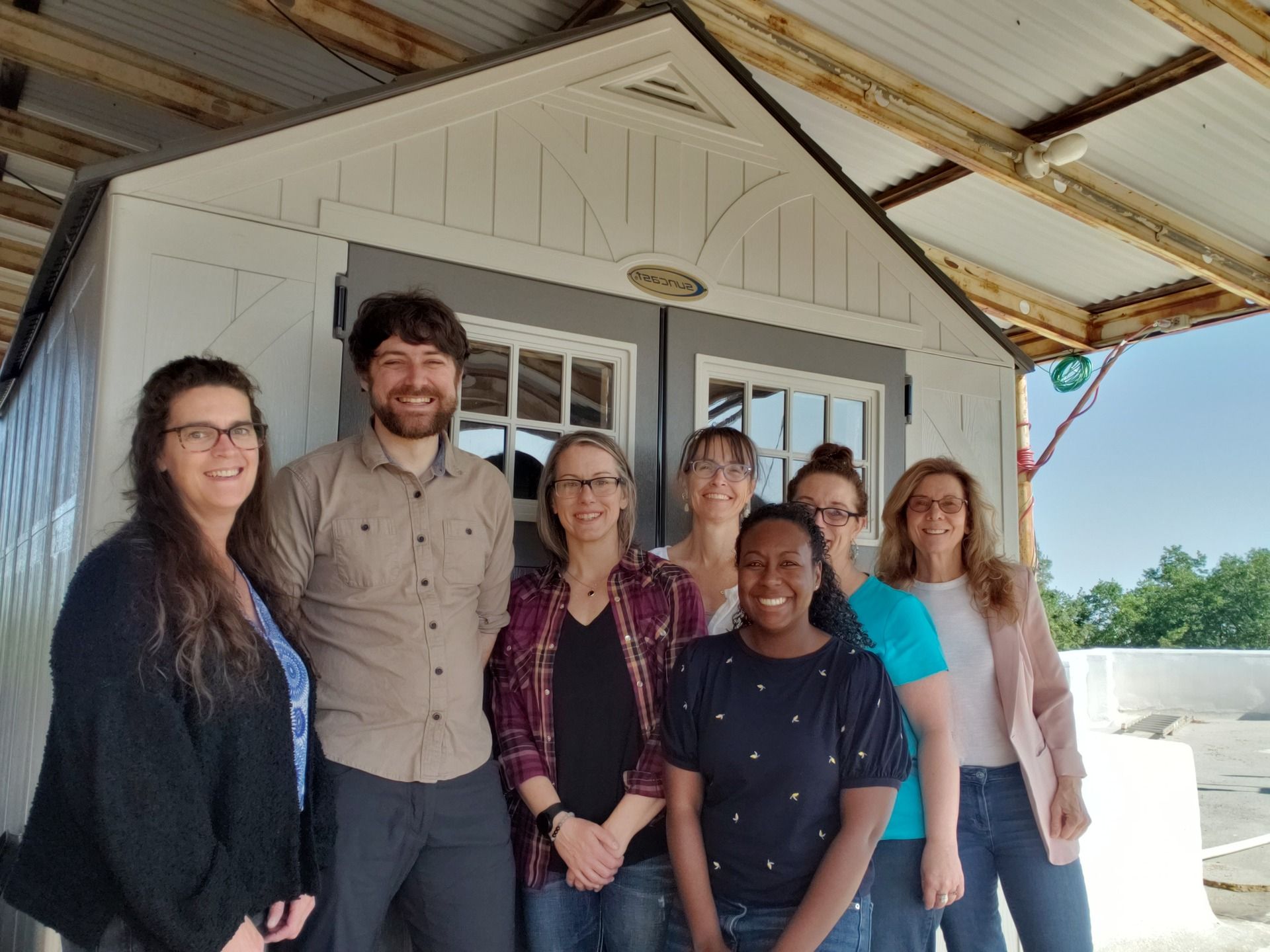
Back row- L to R: Julie Hunter, Executive Director (Smoke Management Program Lead), Scott Coughlin, Air Pollution Control Specialist II (Monitoring Lead), Melissa Klundby, APCS II (Grants Coordinator, Monitoring Tech), Suzie Tarnay, APCS II (Planning Lead, Monitoring Tech), Suzie Tarnay, APCS II (Planning Lead, Monitoring Tech), Teresa Toledo, Admin Assistant, Dawn Lunsford, Admin Assistant II (Accounting Clerk/Office Manager); Front: Tasha Coleman, APCS II (Permitting Lead)
The Northern Sierra Air Management District was formed in 1986 by the merging of the Air Pollution Control Districts of Nevada, Plumas and Sierra Counties. The District is required by state law to achieve and maintain the federal and state Ambient Air Quality Standards, which are air quality standards set at levels that will protect the public health.
The team is split between the three counties and have various roles that all lead to protecting the health of our community. If you ever want to nerd out about all things air quality or environmental science, ask the team for a show-and-tell of their equipment. The PHEP team was able to visit the air quality team at their Litton Building office and take a look at their massive weather station, ozone measuring set up and the real-time measurement of our air quality.
Air Quality
As many of you know and have used (on smoky days for sure!) - the air quality index (AQI) is the standard system used to communicate air quality levels to the public. That system categorizes air quality based on the concentration of specific pollutants and particulate matter in the air. Our air quality team is measuring particulate matter that is fine and inhalable - referred to as PM2.5. They are monitoring our air quality constantly, so when it gets above safe levels, they will be ready to act. In partnership with NCPH and our Health Officer, an air quality advisory or smoke advisory might be issued to notify the community of unhealthy levels.
Prescribed Burns
When there is a planned prescribed burn, the lead agency must receive a “Air Pollution Permit” from the Air District. For more information on what types of burns require a permit, visit: Open Burning - Northern Sierra Air Quality Management District.

US Forest Services
This team does so much for our community that goes unrecognized - but is essential to our well-being. Do yourself a favor and check out their website to see all the great work they’re doing! Northern Sierra Air Quality Management District
 Email us with your story or your nomination of a partner organization - [email protected] |
|
Future Happenings
Do you have a preparedness event that you’d like to share with the coalition? Just send us a quick email and we’ll share it in our next newsletter: [email protected]